
.png)
Novel diagnostics to target pathogens in plant biosecurity


You will be supervised by Dr Jenny Tomlinson (Fera Science Ltd) and Dr Thomas Howard (Newcastle University), combining expertise in synthetic biology, molecular diagnostics, and plant health.

Open to: UK students only, with at least a 2:1 undergraduate degree (and/or equivalent experience) in a relevant subject area.
As a community, GenerationResearch welcomes applications from students of all backgrounds but especially encourages underrepresented groups to apply.
Funding: September 2026 start - September 2029 finish: 3 year full-time PhD studentship (this covers all university tuition fees and research project costs, plus £20,780/year tax free ‘stipend’ for living expenses).
Location: You will primarily be based at Fera Science Ltd, with short visits to Newcastle University for training and technology transfer.
Keywords: Plant health, pathogens, biosecurity, bioinformatics, detection and surveillance
What do we want and what will you do?
We are seeking an enthusiastic and motivated graduate to join a cutting-edge research project focused on advancing plant health diagnostics through synthetic biology. Plant pests and pathogens pose a major threat to agriculture, biodiversity, and biosecurity worldwide. Current diagnostic methods for quarantine pests often rely on complex, multi-step laboratory tests that are difficult to deploy in the field. This work will therefore be crucial in contributing to a new generation of diagnostics that may have implications for food security and conversation.
The successful student will explore innovative synthetic biology approaches to develop rapid, low-cost, and field-deployable tests for detecting quarantine pests/pathogens. They will evaluate technologies such as CRISPR-based systems, strand displacement reactions, and cell-free biosensors, alongside novel mechanisms for sample processing. These approaches aim to simplify nucleic acid detection and enable passive, self-reporting tests that can transform surveillance and response strategies in plant health. Through systematic benchmarking of sensitivity, specificity, cost-effectiveness, and ease of deployment, this research will identify the most promising technologies for real-world application. The outcomes will contribute to UK biosecurity resilience and inform future diagnostic innovation. A great opportunity for anyone interested in applied research, molecular biology, plant science, and working closely with a large UK life science company.
Your PhD community
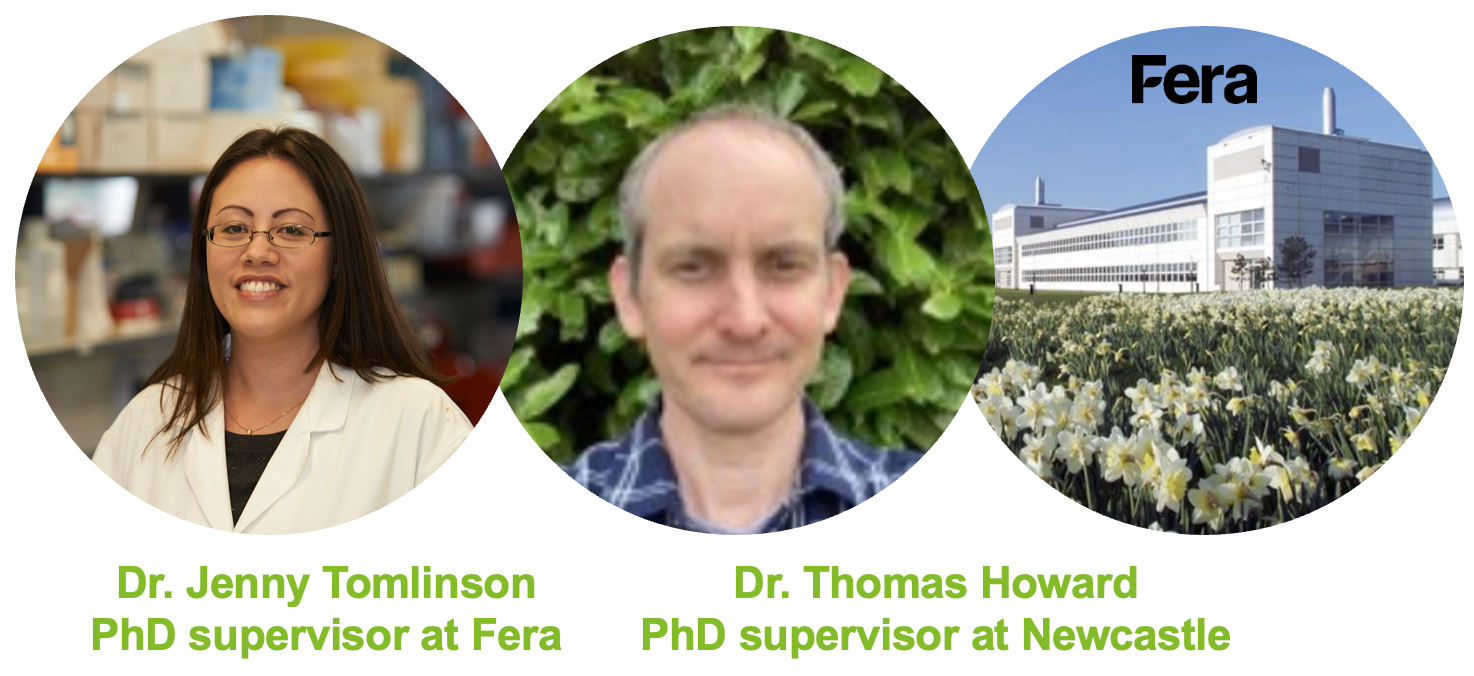
You will be supervised by Dr Jenny Tomlinson (Fera Science Ltd) and Dr Thomas Howard (Newcastle University), combining expertise in synthetic biology, molecular diagnostics, and plant health. Thomas completed his PhD in plant science at the University of Sheffield, and spent a number of years working with both plant and microbial systems, before establishing his own research group in Newcastle. Jenny completed a PhD at the University of Nottingham in 2012, and works in the Detection and Surveillance Technologies team at Fera on the diagnosis and detection of plant pests and pathogens. You will be primarily based at York Biotech Campus (Sand Hutton), with short visits to Newcastle for training and technology transfer.
Fera Science Ltd is a world-leading analytical laboratory with a strong track record in developing and deploying cutting-edge diagnostic technologies, including qPCR, LAMP, and high-throughput sequencing. Newcastle University offers a vibrant research environment with access to advanced synthetic biology and molecular biology facilities.
You will join a collaborative network spanning academia, government, and industry, with opportunities to engage with Defra and APHA stakeholders and contribute to national biosecurity strategy.
A focus on technical skill development
As well as learning about plant pathogens and health with your PhD team at Fera and Newcastle, we will support you to learn a number of key technical skills, including in synthetic biology, in vitro assays and designing your own diagnostic experiments. When you first begin, and as you require throughout your work, training will include access to Newcastle’s synthetic biology facilities and the analytical laboratories and quarantine facilities at Fera. This can include workshops, seminars, and mentoring with colleagues who have the experience to help you in your studies. Have a look at some of the scientists who already work at Fera here. You may also have opportunities to present your work at national/international conferences and publish your work in peer-reviewed journals.
Applications are now closed.