
.png)
Host and vector-borne viral risks in trade: Understanding virus introduction by the vector Bemisia tabaci


You will be supervised by Adrian Fox (Fera Science Ltd), Eleanor Jones (Fera Science Ltd) and Sophie Bouvaine (University of Greenwich), combining expertise in synthetic biology, molecular diagnostics, and plant health.

Open to: UK students only, with at least a 2:1 undergraduate degree (and/or equivalent experience) in a relevant subject area.
As a community, GenerationResearch welcomes applications from students of all backgrounds but especially encourages underrepresented groups to apply.
Keywords: Plant health, pathogens, virology, entomology, bioinformatics, detection and surveillance
Funding: September 2026 start - September 2029 finish: 3 year full-time PhD studentship (this covers all university tuition fees and research project costs, plus £20,780/year tax free ‘stipend’ for living expenses).
Location: Fera Science Ltd (York) for the first year of the PhD, followed by two years at the Natural Resources Institute (NRI), University of Greenwich
What do we want and what will you do?
We are seeking an enthusiastic and motivated graduate to join a cutting-edge research project. Global trade in plants and plant products is expanding rapidly, as is the movement of plant pests and the viruses they carry. One of the most significant threats is the highly polyphagous whitefly, Bemisia tabaci, a vector capable of transmitting hundreds of damaging plant viruses. Crucially, B. tabaci is a cryptic species complex comprising numerous morphologically indistinguishable but genetically distinct species, each varying in distribution, host range, and virustransmission capacity. Viruses can enter new regions silently, hidden within traded plant material, before establishing and causing devastating impacts on agriculture and ecosystems. This PhD project offers the student an opportunity to tackle a plant health challenge facing regulators and growers worldwide: How do we better understand, predict, and mitigate the viral risks associated with the international movement of plants and the associated introduction of B. tabaci and its host plants. This PhD project aims to improve understanding of the B. tabaci pathosystem across import pathways in ornamental and edible horticulture in the UK. A great opportunity for anyone interested in applied research, molecular biology, plant science, virology and working closely with a large UK life science company.
Your PhD community
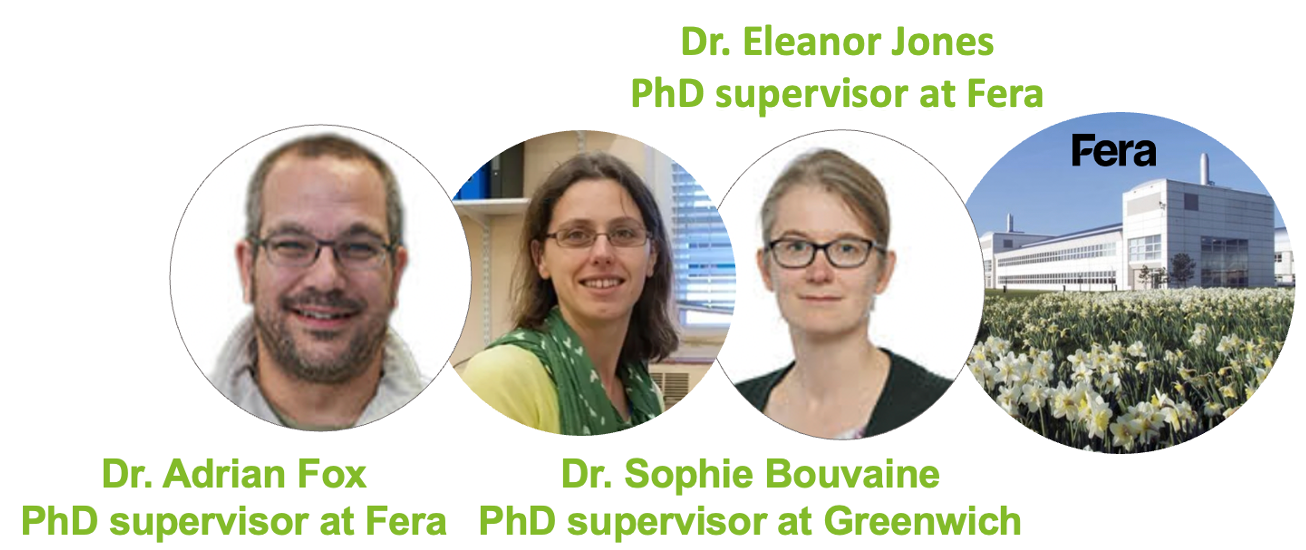
You will be supervised by Adrian Fox (Fera Science Ltd), Eleanor Jones (Fera Science Ltd) and Sophie Bouvaine (NRI - University of Greenwich), combining expertise in molecular diagnostics and plant health.
Sophie graduated from the University of York with a PhD, in which she studied the transmission of a major cereal disease by aphids. Dr Bouvaine is a Senior Lecturer at the Natural Resources Institute (NRI), University of Greenwich. She is a molecular biologist focusing on insect vectors of plant viruses. Adrian Fox is Senior Plant Virologist at Fera and gained his PhD at Warwick University while working at Fera. As lead virologist, his role is to deliver a high-quality virology diagnostic service to a wide range of UK and overseas government and commercial clients. Eleanor Jones graduated from the University of York with a PhD. Eleanor is a molecular geneticist at Fera, applying DNA typing and sequencing methods to detect and identify species.
You will be based at Fera Science Ltd, near York, for the first year of the PhD, followed by two years at the Natural Resources Institute (NRI), University of Greenwich (Medway campus-Kent). Fera Science Ltd is a world-leading analytical laboratory with a strong track record in developing and deploying cutting-edge diagnostic technologies, including qPCR, LAMP, and high-throughput sequencing. You will join a collaborative network spanning academia, government, and industry.
A focus on technical skill development and key objectives
As well as learning about plant pathogens and vectors, your PhD team at Fera and Greenwich will support you to learn a number of key technical skills with a clear focus on objectives. Objective 1 will focus on molecular diagnostic development, where the student will design and optimise tests to identify B. tabaci and detect a broad range of viruses they carry. In Objective 2, the student will apply these tests on plant and insect samples, in order to investigate specific association between specific viruses and B. tabaci species, and how to assess wide-spread these relationships are. Finally, Objective 3 will involve conducting controlled virus-insect transmission experiments, in which the student will gain valuable skills in experimental design and hands-on experience of working in an insectary. This will ultimately evaluate the risk of virus transmission in different scenarios.
Have a look at some of the scientists who already work at Fera here. You will also have opportunities to present your work at national/international conferences and publish your work in peer-reviewed journals.
Applications are now closed.